4 minute read · Brand comparison
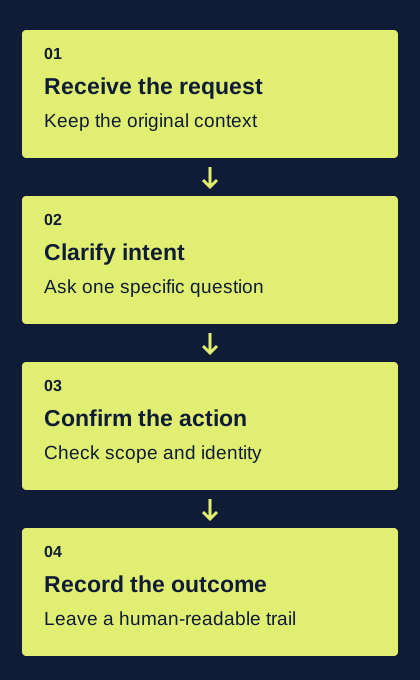
An agent needs a channel contract
Linq and Photon both advertise ways to bring agents into messaging, but an agent application needs more than the ability to send text. It needs to know who is speaking, which conversation a reply belongs to and which actions are supported on the active channel. Those details determine whether a model can continue a task correctly when a rich iMessage exchange becomes a simpler fallback conversation.
This is an evaluation of public product and plan descriptions checked September 28, 2026. It is not a benchmark of latency, availability or model performance. Our recommendation is to compare the documented production configuration and a small acceptance pack. Neither a customer logo nor a successful sample request establishes how your own agent will behave when an event is late or a human intervenes.
| Decision | Linq | Photon |
|---|---|---|
| Published direction | Developer messaging infrastructure and integrations | Agent messaging with managed and open-source paths |
| Plan visibility | Request a scoped production price | Free, Pro, Business and Enterprise tiers |
| Managed sender model | Confirm the production assignment in the quote | Free/Pro shared; Business dedicated |
| Dedicated price anchor | No numeric production quote confirmed here | $250 per line/month for Business |
| Main acceptance question | Which channel product and event contract are we buying? | Which tier covers our users, groups and sender identity? |
Linq: establish the exact product boundary
Linq’s homepage advertises native iMessage, RCS, SMS and voice alongside developer tooling. Its documentation landing page also separates Apple Messages, WhatsApp and iMessage areas. Do not treat every Apple-related messaging surface as one interchangeable API. Ask which product, onboarding path and identity model applies to the configuration your team is considering.
Request a production proposal covering the sender, supported recipient countries, required channels and the volume profile of your application. If a service commitment matters, retain the actual agreement rather than quoting a homepage uptime figure as a guarantee. A quote-led purchase can be appropriate for a tailored deployment, provided the engineering team gets enough detail to evaluate the integration before committing.
Photon: distinguish a useful prototype from its production tier
Photon’s pricing page explicitly marks Free and Pro numbers as managed shared and Business as managed dedicated. That is helpful when deciding whether a trial proves the intended identity model. Its Business plan also lists group messaging and an Auto Scale qualification on unlimited users. Those are plan conditions to clarify, not details to discover after public onboarding starts.
Build a small experiment around the actual production feature you need. If the agent will coordinate a group, a direct-message test on an entry tier is incomplete. If a recognizable dedicated number is part of the product, confirm how an upgrade affects existing participants. The existence of an open-source option is a separate operating choice; it should not be mixed into a managed-hosting price without accounting for infrastructure work.
Give each transport feature an application consequence
For every advertised feature, write the behavior your application needs. A read receipt may be useful context but should not authorize the agent to assume a customer agreed. A typing indicator can make a wait clearer but should stop when work fails. An attachment should become a referenced object with its own handling rules, not an unexplained string copied into the model’s context.
Then describe the fallback behavior. A task that depends on a rich reaction or group interaction may need a plain-text alternative or human escalation on another channel. Ask both vendors to show which channel and event fields expose that distinction. Your application should choose how to adapt; it should not infer that every recipient saw the same interface because the sending call returned successfully.
Run a bounded acceptance pack
Use controlled test participants and a fictional scheduling task. Include a normal reply, a correction, a duplicate event, a delayed event and a request for a person. Keep the intended state changes written down in advance. This lets you distinguish a transport issue from a model misunderstanding or a bug in your own conversation store.
Do not invite the agent to take consequential actions during the first transport test. Record the proposed action and check it against the expected result. Once the messaging path is understood, enable a small approved action and verify its result independently. This sequence makes a provider comparison easier to interpret because an agent’s fluent response is not mistaken for a correctly completed external task.
The decision rests on the complete deployment
Linq belongs on the shortlist when your team wants to work through a scoped messaging integration and can obtain the specific channel, commercial and service terms it needs. Photon belongs there when its visible tier structure and shared-to-dedicated path fit the development plan. Those are procurement distinctions, not a claim that either provider is universally better for AI.
Choose after documenting the production number, user or contact allowance, group support, fallback contract and recovery procedure. Keep your own state machine and human handoff separate from vendor marketing about agent capability. The supplier moves messages; your application still has to determine whether a request was understood, whether an action is allowed and when the conversation needs a responsible person.